Can an Enlarged Prostate Cause Back Pain? The Red Flags That Matter
Affiliate disclosure: some links on this site are affiliate links. If you buy through them we may earn a commission at no extra cost to you. That never changes what the research says, and we publish negative findings about products we link to. This article is informational and is not medical advice.
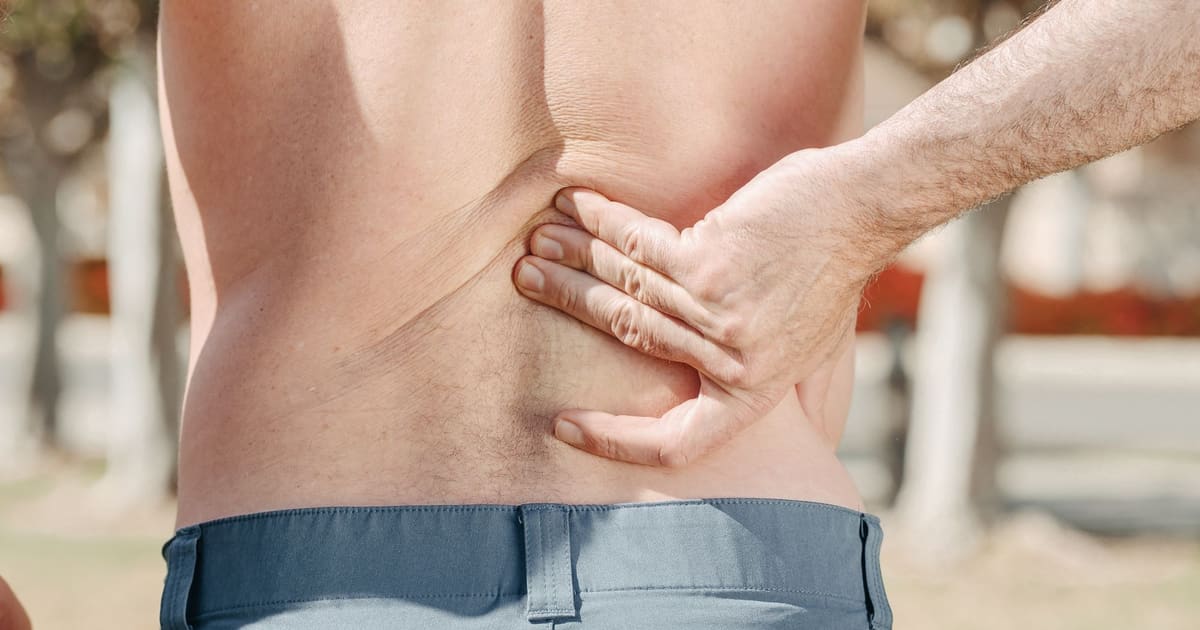
An enlarged prostate does not usually cause back pain by itself: back pain is not on the NIDDK list of BPH symptoms.1 But back pain together with new trouble urinating, numbness between the legs or fever needs prompt care, and with numbness or loss of bladder control it can be a surgical emergency.4,6
Go to the emergency room or call 911 now if you have back pain together with any of these: numbness or tingling between your legs, around your anus or on your inner thighs; new trouble starting to urinate, being unable to urinate, or leaking urine you cannot control; loss of bowel control; or weakness or numbness in both legs. These are warning signs of cauda equina syndrome, which orthopedic surgeons call "a surgical emergency."4,5,6
Key takeaways
- The NIDDK's list of BPH symptoms covers urination only: trouble starting, weak stream, dribbling, night urination, urgency, frequency and pain during urination. Back pain is not on it.1
- Back pain and urinary symptoms often show up together anyway: in a 2026 study of 101 men with chronic low back pain, 66.3 percent had moderate to severe urinary symptoms (IPSS above 7).8
- In 159 patients with lumbar spinal stenosis, 30.8 percent had urinary symptoms, and they had more back and leg pain than those without.9
- For cauda equina syndrome, the AANS says treating within 48 hours of onset "provides a significant advantage" for nerve, bladder and bowel recovery.5
- Common back pain medicines, including NSAIDs such as ibuprofen and opioids, are on the NIDDK's list of drugs that can cause urinary retention.3
Does an enlarged prostate cause back pain?
Not directly, in the vast majority of cases. Benign prostatic hyperplasia (BPH) is a gland that has grown around the urethra. When it causes trouble, the trouble is with urinating. The NIDDK lists the symptoms as difficulty starting a stream or emptying the bladder, a weak or interrupted stream, dribbling, waking at night to urinate, urgency, frequency and pain during urination.1 Our full guide to enlarged prostate symptoms walks through each one.
Where the prostate and the back do meet is through complications and through other conditions that share the same symptoms. The NIDDK lists kidney disease among BPH complications, and notes that the same urinary symptoms can also come from bladder problems, infections, prostatitis or prostate cancer.1 Each of those can involve back or side pain. So the useful question is not "can my prostate cause this?" but "what does this particular combination of back pain and urinary symptoms point to?"
Why back pain and urinary symptoms often show up together
Both are common after 50, so many men have both without one causing the other. The previous American Urological Association guideline (2021, amended 2023) cites Olmsted County data in which moderate to severe urinary symptoms rise to nearly 50 percent of men by their seventies.2
Recent studies show the overlap is larger than chance would suggest in some groups:
- Chronic low back pain: in a 2026 cross-sectional study of 101 men (mean age 52), 66.3 percent had moderate to severe urinary symptoms on the IPSS. Anxiety and erectile dysfunction were the factors independently linked to the urinary symptoms.8
- Lumbar spinal stenosis (narrowing of the spinal canal in the lower back): 49 of 159 patients (30.8 percent) had urinary symptoms. They were more likely to have low back pain (93.9 vs 77.3 percent) and leg pain (57.1 vs 34.5 percent) than patients without urinary symptoms.9
These studies are small and observational, so they cannot prove which came first. What they do show is that the nerves that run the bladder pass through the lower spine, and a back problem can sometimes be the reason a man's urinary symptoms changed.4,9 If you have both, mention both at the same visit.
The red flag map: what each combination can mean
| If you have back pain plus... | It can point to | How fast | Source |
|---|---|---|---|
| Numbness between the legs, buttocks or inner thighs; new trouble urinating or leaking; loss of bowel control; weakness in both legs | Cauda equina syndrome (compressed nerve roots in the lower spine) | Emergency now | AAOS, AANS, NHS4,5,6 |
| Fever, chills and painful, frequent or urgent urination | Acute prostatitis or another urinary infection | Same day | NIDDK1,7 |
| Sharp pain in the back, side or groin, blood in the urine, nausea | Kidney stone or a more serious condition | Right away | NIDDK10 |
| Side (flank) pain with a very weak stream, a bladder that never empties, or much less urine | Urine backing up toward the kidneys (hydronephrosis) | Promptly | MedlinePlus, NIDDK11,1 |
| Bone pain in the hips, spine or ribs, weight loss, tiredness | Must rule out prostate cancer that has spread | Soon | American Cancer Society12 |
| Aching low back, pelvis or groin for 3 months or more, pain with ejaculation | Chronic prostatitis / chronic pelvic pain syndrome | Regular appointment | NIDDK7 |
| Back pain only, urination unchanged, no fever | Most often a back problem, not the prostate | Routine | NHS6 |
Cauda equina syndrome: the emergency to recognize
The cauda equina is the bundle of nerve roots at the lower end of the spinal cord. When they are squeezed, for example by a herniated disk, a tumor, an infection, a fracture or lumbar spinal stenosis, the nerves that control the bladder and bowel are "especially vulnerable to damage," according to the American Academy of Orthopaedic Surgeons (AAOS).4
The AAOS lists the warning signs: being unable to urinate or unable to hold urine, and severe or worsening numbness, tingling or burning between the legs, over the buttocks, on the inner thighs or the backs of the legs, or in the feet. Numbness in the area a saddle would touch is called "saddle anesthesia."4 The NHS adds pain, tingling, weakness or numbness in both legs, and changes in how the penis feels during sex or new trouble getting an erection, alongside back pain.6
Here is why this matters on a prostate site. A man who already has BPH may write off new trouble starting his stream as "just the prostate getting worse." The difference is the company it keeps. BPH builds slowly and does not cause numbness. Trouble urinating that arrives together with back pain and numbness in the saddle area is a nerve problem until proven otherwise.
Speed changes the outcome. The AANS states that "treating patients within 48 hours after the onset of the syndrome provides a significant advantage in improving sensory and motor deficits as well as urinary and rectal function."5 The NHS advises not to drive yourself: ask someone to drive you or call for an ambulance.6
Can an enlarged prostate cause kidney problems and side pain?
It can, though it is uncommon. When the prostate narrows the outlet, the bladder works harder, and over time it may stop emptying completely.1 If urine cannot drain properly, it can back up into the kidneys. MedlinePlus explains that hydronephrosis, a swelling of the parts of the kidney that collect urine, happens when urine is unable to drain from the kidney into the bladder, and lists bladder outlet obstruction as one cause. In adults its symptoms can include back pain, nausea, vomiting, fever, frequent urination, less urine and blood in the urine, and it warns that irreversible kidney damage may result.11
This is one of the reasons kidney trouble is taken seriously in BPH care. The previous AUA guideline recommends surgery for men who have "renal insufficiency secondary to BPH."2 The warning pattern is not the back pain alone; it is side pain together with a stream that has become very weak, a bladder that never feels empty, or much less urine than usual. Our guide on a bladder not emptying completely explains how leftover urine is measured.
Prostate infection and pelvic pain that reaches the back
Prostatitis, an inflamed or infected prostate, is a different condition from BPH, and it is the prostate problem most clearly linked to back pain. The NIDDK lists pain in the genital area, groin, lower abdomen or lower back among the symptoms of acute and chronic bacterial prostatitis. Acute bacterial prostatitis comes on suddenly with fever and chills, and the NIDDK says men should seek immediate medical care.7
A long-lasting form, chronic prostatitis/chronic pelvic pain syndrome, causes pain or discomfort for 3 months or more in places that can include the area between the scrotum and anus, the lower belly, the penis, the scrotum and the lower back, often with pain during or after ejaculation.7 It is not an emergency, but it deserves a proper diagnosis.
Enlarged prostate and leg or hip pain
BPH itself does not cause leg or hip pain. When hip, back or rib pain appears in a man with urinary symptoms, the condition a doctor will want to rule out is advanced prostate cancer. The American Cancer Society lists pain in the hips, back (spine), chest (ribs) or other areas from cancer that has spread to the bones, along with weakness or numbness in the legs, weight loss and fatigue, as possible signs of advanced disease.12
Keep this in proportion. The same page notes that early prostate cancer usually causes no symptoms, and that trouble urinating "is much more often caused by benign prostatic hyperplasia."12 Bone pain plus weight loss is a reason to book a visit soon and ask about a PSA test, not a reason to panic. See what age to get a PSA test for how the test works.
The back pain medicine connection most pages miss
Sometimes the link runs the other way: the treatment for the back affects the bladder. The NIDDK's list of medicines that can cause urinary retention includes nonsteroidal anti-inflammatory drugs such as aspirin and ibuprofen, opioids, antispasmodics and benzodiazepines.3 Several of those are standard back pain treatments.
For a man whose prostate already narrows the outlet, a new pain pill can be the thing that tips a weak stream into real trouble emptying. If your urination changed within days of starting a back pain medicine, tell the prescriber. Do not stop or change a prescribed medicine without your doctor, but do report the change quickly, and get care right away if you cannot urinate at all.3
When back pain is probably not your prostate
If your back hurts, your urination has not changed, and you have no fever, numbness or weight loss, the back is the likely source. The NHS notes that back pain often improves on its own within a few weeks and advises staying active.6 It recommends urgent advice if you feel hot, cold or shivery, or if the pain is severe, starts suddenly or gets worse quickly.6
Your urinary symptoms still deserve their own look. A quick way to put a number on them is our IPSS score calculator; bring the result to your visit. If the bowel is part of the picture, our page on enlarged prostate and constipation explains how a full rectum can affect the bladder.
What the doctor will check
Expect questions about when each symptom started and which came first. For the urinary side, the NIDDK describes a medical history, a physical exam including a digital rectal exam, and tests such as a urinalysis and a PSA blood test.1 For a possible nerve problem, the AAOS describes a check of strength, sensation and reflexes, possibly a rectal exam to test muscle tone and numbness, a post-void residual ultrasound to measure urine left in the bladder, and imaging such as MRI.4
Bring your medicine list, including over-the-counter pain relievers and cold medicines. The NIDDK says decongestants, antihistamines, tranquilizers, antidepressants and diuretics can make BPH symptoms worse.1
Where a supplement fits
No supplement treats back pain from the prostate, and none should delay care for the red flags above. Prostate supplements are aimed at urinary symptoms only, and their evidence is mixed at best. If your doctor has ruled out the urgent causes and you are considering one for urinary symptoms, read the label before you buy: each ingredient, its dose, and whether that dose matches the studies. Our guide on how to read a prostate supplement label shows how. The AUA's 2026 guideline also says that "behavioral and lifestyle interventions should be explored before or alongside pharmacologic treatment."13
If your doctor has ruled out the red flags and you want to try a supplement that comes with a money-back guarantee, ProtoFlow is the one we analyzed in full. Its maker says it "supports the normal functions of the bladder, prostate and reproductive system". Our analysis checks that claim against the label, the published research and the refund terms.
A practical plan for this week
- Check the emergency list first. Numbness between the legs, new inability to urinate or leaking, or weakness in both legs: go now.
- Note the timeline. Write down when the back pain started and when the urinary changes started.
- List every medicine you started recently, especially pain relievers and cold or sleep products.
- Score your urinary symptoms with the IPSS and keep the number.
- Book a visit if you have fever, side pain, bone pain or weight loss, or if the urinary symptoms are new.
Frequently asked questions
Can an enlarged prostate cause lower back pain?
Not usually by itself. The NIDDK lists the symptoms of benign prostatic hyperplasia as urinary ones, such as a weak stream, urgency and waking at night to urinate, and back pain is not among them. Back pain with urinary symptoms can come from prostatitis, a kidney problem, a spine problem or, less often, prostate cancer, so the combination deserves a checkup.
When is back pain with urinary problems an emergency?
Go to the emergency room now if back pain comes with numbness between your legs or around your anus, new trouble urinating or leaking urine, loss of bowel control, or weakness in both legs. These can be signs of cauda equina syndrome, which the American Academy of Orthopaedic Surgeons calls a surgical emergency. Fever and chills with painful urination also need same-day care.
Can prostate problems cause pain in the legs or hips?
Benign prostatic hyperplasia does not. The American Cancer Society lists pain in the hips, spine or ribs, and weakness or numbness in the legs, as possible signs of advanced prostate cancer that has spread. It also notes that trouble urinating is much more often caused by benign prostatic hyperplasia, so leg or hip pain is a reason to see a doctor, not to assume the worst.
Can an enlarged prostate damage the kidneys?
It can, though it is uncommon. The NIDDK lists kidney disease among the complications of benign prostatic hyperplasia. If urine cannot drain, it can back up and swell the kidneys, a condition called hydronephrosis, which MedlinePlus says can cause back pain and may lead to irreversible kidney damage. The previous American Urological Association guideline recommends surgery when BPH causes kidney problems.
Why do I have lower back pain and frequent urination?
The two often occur together in men over 50 without one causing the other. In a 2026 study of 101 men with chronic low back pain, 66.3 percent had moderate to severe urinary symptoms. Possible shared causes include prostatitis, a urinary infection, a kidney stone or a spine problem affecting bladder nerves. If fever or numbness is present, get care promptly.
Can back pain medicine make urination harder?
Yes. The NIDDK lists nonsteroidal anti-inflammatory drugs such as aspirin and ibuprofen, opioids, antispasmodics and benzodiazepines among the medicines that can cause urinary retention. Men with an enlarged prostate should tell the prescriber if urination changes after starting a pain medicine, and get care right away if they cannot urinate at all.
Does prostatitis cause back pain?
It can. The NIDDK lists lower back pain among the symptoms of acute and chronic bacterial prostatitis, and of chronic prostatitis/chronic pelvic pain syndrome. Acute bacterial prostatitis comes on suddenly with fever and chills and needs immediate medical care.
Sources
- National Institute of Diabetes and Digestive and Kidney Diseases (NIH). Enlarged Prostate (Benign Prostatic Hyperplasia). https://www.niddk.nih.gov/health-information/urologic-diseases/prostate-problems/enlarged-prostate-benign-prostatic-hyperplasia
- American Urological Association. Management of Lower Urinary Tract Symptoms Attributed to Benign Prostatic Hyperplasia: AUA Guideline (2021, amended 2023), unabridged. Previous version, replaced on May 7, 2026. https://www.auanet.org/documents/Guidelines/PDF/2023%20Guidelines/BPH%20Unabridged%2002-20-24%20Final.pdf
- National Institute of Diabetes and Digestive and Kidney Diseases (NIH). Symptoms and Causes of Urinary Retention. https://www.niddk.nih.gov/health-information/urologic-diseases/urinary-retention/symptoms-causes
- American Academy of Orthopaedic Surgeons, OrthoInfo. Cauda Equina Syndrome. https://orthoinfo.aaos.org/en/diseases--conditions/cauda-equina-syndrome/
- American Association of Neurological Surgeons. Cauda Equina Syndrome. https://www.aans.org/patients/conditions-treatments/cauda-equina-syndrome/
- NHS (UK National Health Service). Back pain. Page last reviewed March 5, 2026. https://www.nhs.uk/conditions/back-pain/
- National Institute of Diabetes and Digestive and Kidney Diseases (NIH). Prostatitis: Inflammation of the Prostate. https://www.niddk.nih.gov/health-information/urologic-diseases/prostate-problems/prostatitis-inflammation-prostate
- Rouached L, Mourad Dali K, Bouden S, et al. Lower urinary tract symptoms in men with chronic low back pain: a cross-sectional study. French Journal of Urology. 2026;36(2):103070. https://pubmed.ncbi.nlm.nih.gov/41506552/
- Hodzic H, Beculic H, Begagic E, et al. Lower urinary tract symptoms (LUTS) as a clinical feature of lumbar spinal stenosis (LSS): a prospective study with lumbar spine morphometry analysis. Medicinski Glasnik. 2025;22(1):104-110. https://pubmed.ncbi.nlm.nih.gov/40129333/
- National Institute of Diabetes and Digestive and Kidney Diseases (NIH). Symptoms and Causes of Kidney Stones. https://www.niddk.nih.gov/health-information/urologic-diseases/kidney-stones/symptoms-causes
- MedlinePlus Medical Encyclopedia (NIH National Library of Medicine). Bilateral hydronephrosis. https://medlineplus.gov/ency/article/000474.htm
- American Cancer Society. Signs and Symptoms of Prostate Cancer. https://www.cancer.org/cancer/types/prostate-cancer/detection-diagnosis-staging/signs-symptoms.html
- American Urological Association. Management of Lower Urinary Tract Symptoms Attributed to Benign Prostatic Hyperplasia: AUA Guideline (2026). Released May 7, 2026; replaces the 2021 guideline amended in 2023. https://www.auanet.org/2026BPHGuideline

About the author
Alice Hess is a health researcher and wellness writer at ProstateClarity. She is not a doctor, a nurse, a nutritionist or any kind of licensed clinician, and nothing here is medical advice. She started this work because of her father: at 76 he was getting up several times a night, and the research she did for him helped him get back to sleeping through the night. One man's story is not evidence, which is why every guide here is built on published research. She reads labels, primary research and regulatory limits, and publishes the numbers manufacturers leave out. More about her work and how these articles are researched.
Found an error? Write to contact@prostateclarity.com with the sentence and the source that contradicts it. Corrections are made in the article with the date noted.